> ## Documentation Index
> Fetch the complete documentation index at: https://docs.poelis.com/llms.txt
> Use this file to discover all available pages before exploring further.
# Products - User manual
Products are the core units of engineering work in Poelis. A product represents a **system or subsystem** and is the primary way to organize engineering data, items, and lifecycle states inside a workspace.
Products live inside a workspace and are **independently versioned**. Versions allow you to capture snapshots of the product, share increments with stakeholders, and track evolution over time.
## What is a Product?
A product is where you model and evolve a complete system or subsystem:
* It contains a collection of **items**, each representing a discrete engineering concept (e.g., requirement, component, interface).
* It includes **properties**, **relationships**, and **documents** that describe the product’s structure and content.
* It maintains version history, enabling you to trace what changed, when, and by whom.
## Versions
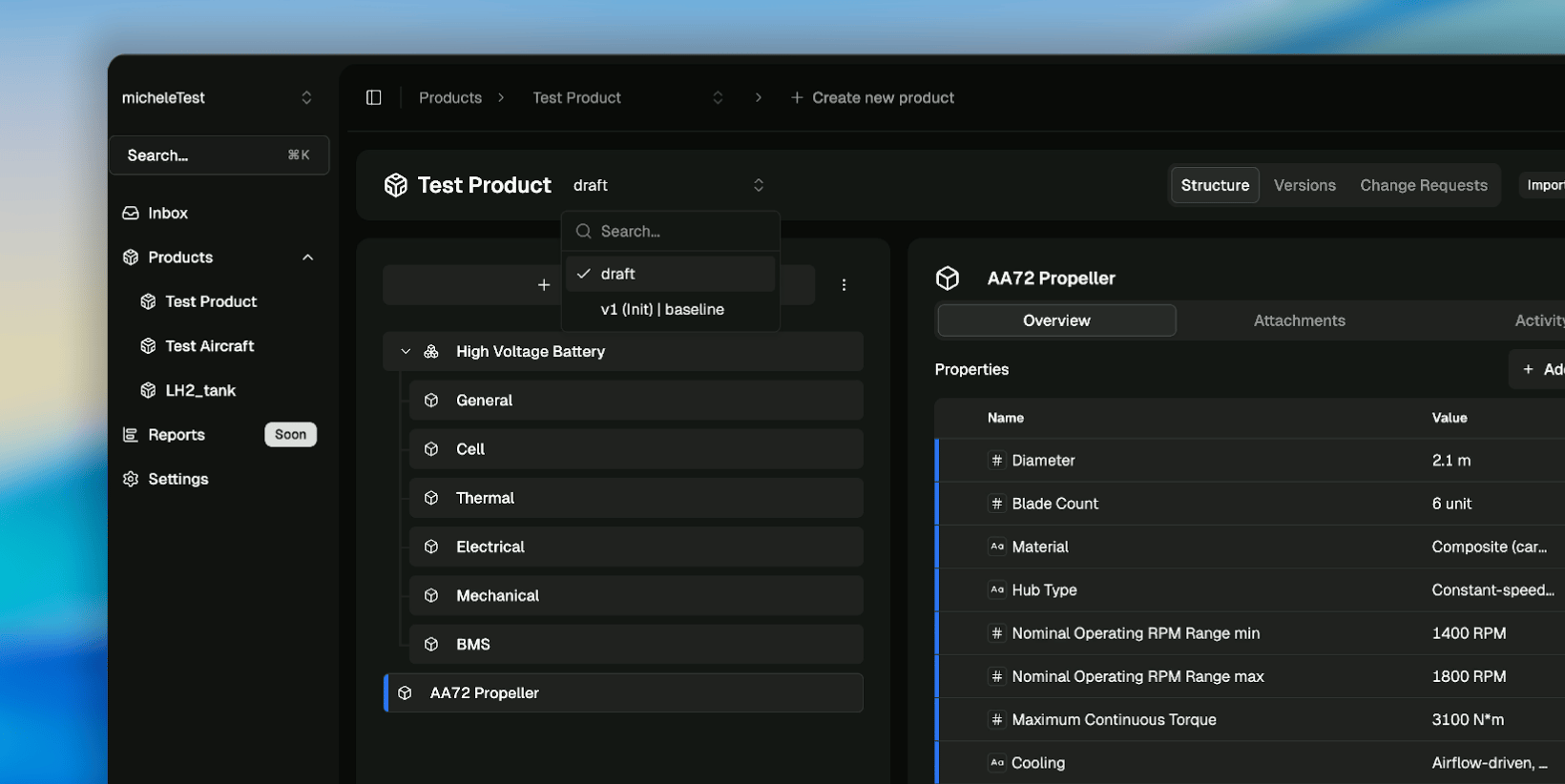
Every product has exactly **one active working version** called **draft**. This is the version you edit day-to-day.
 ### How Versions Work
* The draft version is **editable**: add, update, or remove items, properties, and documents.
* When you publish a version, Poelis takes a snapshot of the draft and creates a point-in-time version.
* Published versions are **immutable:** once created, the contents cannot be changed.
* Only the draft can receive changes after publishing.
This model gives you a clean separation between *ongoing work* and *released snapshots*.
## Baselines
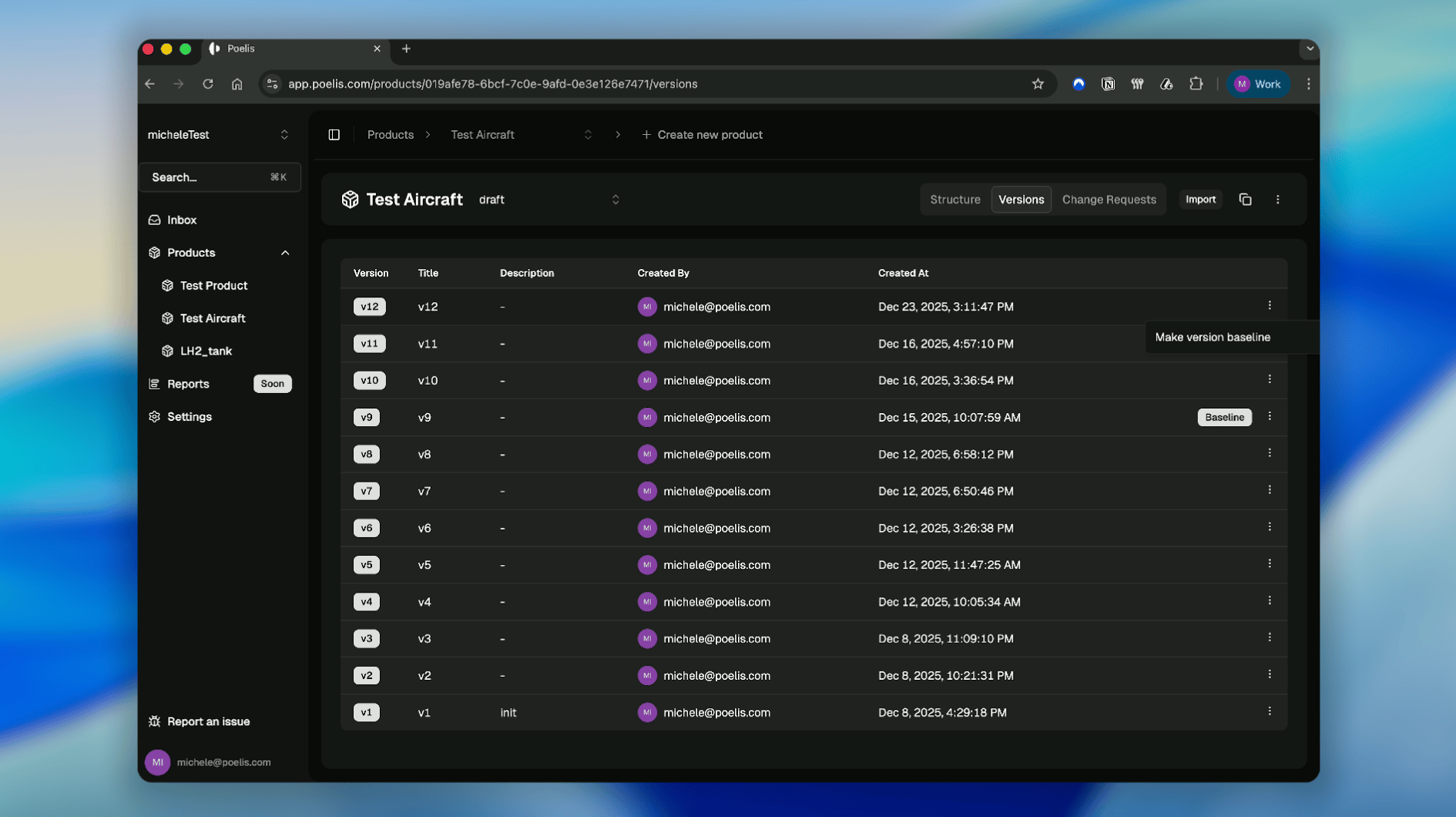
A **baseline** is a special version you designate as the product’s reference state.
* Baselines are also immutable.
* Only one version can be marked as the baseline at a time.
* You can change which version is the baseline at any point.
Use baselines to record important milestones such as reviews, compliance gates, or delivery commitments.
### How Versions Work
* The draft version is **editable**: add, update, or remove items, properties, and documents.
* When you publish a version, Poelis takes a snapshot of the draft and creates a point-in-time version.
* Published versions are **immutable:** once created, the contents cannot be changed.
* Only the draft can receive changes after publishing.
This model gives you a clean separation between *ongoing work* and *released snapshots*.
## Baselines
A **baseline** is a special version you designate as the product’s reference state.
* Baselines are also immutable.
* Only one version can be marked as the baseline at a time.
* You can change which version is the baseline at any point.
Use baselines to record important milestones such as reviews, compliance gates, or delivery commitments.
 ## Change Requests
Publishing a version doesn’t automatically include all draft changes. Instead, Poelis uses **Change Requests** to let you choose exactly what should be part of the next version.
When you start a Change Request:
1. Poelis shows a list of items and properties that have changed in the draft.
2. You select which changes should be included in the next version.
3. You finalize the selection and publish the version.
Change Requests help you create controlled, intentional releases. They make it easy to review changes before they become part of a shareable version.
## Publishing a Version
Only **Admins** and **Product Owners** can publish a version. Poelis supports two ways to do it: **publish immediately** or **publish with approvals**.
### Option 1: Publish immediately
1. Open the **Change Requests** tab.
2. Select the items and properties to include.
3. Add a **title** and optional **description**.
4. (Optional) Enable **Make this version the baseline**.
5. Click **Publish Version**.
### Option 2: Publish with approvals (review loop)
Use this when you want reviewers to approve changes before publishing.
1. Open the **Change Requests** tab.
2. Click **Request Review**.
3. Add **Reviewers**.
4. Choose an **Approval Mode**:
* **Any** — one reviewer approval is enough.
* **All** — everyone must approve (in any order).
* **Sequential** — everyone must approve **in order**.
5. Add a **Version Title** and optional **Version Description**.
6. (Optional) Enable **Make this version the baseline**.
7. Click **Request Review**.
### What happens next
* A review is created with status **Pending**.
* You can track it from the **Reviews** tab or open it from the version panel via **Go to active review**.
* Reviewers can leave comments, **approve**, or **reject**.
### Completing the review
Reviewers open the review and click **Submit Review**, then choose one:
* **Comment** — leave feedback without approving/rejecting.
* **Approve** — counts toward the approval requirements.
* **Reject** — closes the review; changes remain in draft.
When the approval requirements are met, an **Admin** or **Product Owner** can publish the version (in some cases this is available directly as **Approve and release version**, depending on permissions).
### After publishing
* A new **immutable** version appears in the product’s version list.
* The **draft remains editable** for ongoing work.
[Watch video: clipNewVersion](https://poelis.notion.site/2d9ead995b3480de91e4cbc518b19e32#2d6ead995b3480bdb106ef740cb8a08c)
## Duplicating a Product
Poelis lets you duplicate an existing product to create a new one with the same structure and content.
When duplicating, you can:
* Choose a **name** and **readable ID** for the new product.
* Select which **version** to copy (commonly draft).
* Include items, properties, documents, and dependencies.
The duplicated product is independent: it has its own draft, versions, and lifecycle. Changes to the original product do not affect the copy.
## When to Create a Product
Create a new product when:
* You are modeling a distinct system or subsystem.
* You need a separate version history from existing products.
* You want to manage a different set of items, releases, or baselines.
## Change Requests
Publishing a version doesn’t automatically include all draft changes. Instead, Poelis uses **Change Requests** to let you choose exactly what should be part of the next version.
When you start a Change Request:
1. Poelis shows a list of items and properties that have changed in the draft.
2. You select which changes should be included in the next version.
3. You finalize the selection and publish the version.
Change Requests help you create controlled, intentional releases. They make it easy to review changes before they become part of a shareable version.
## Publishing a Version
Only **Admins** and **Product Owners** can publish a version. Poelis supports two ways to do it: **publish immediately** or **publish with approvals**.
### Option 1: Publish immediately
1. Open the **Change Requests** tab.
2. Select the items and properties to include.
3. Add a **title** and optional **description**.
4. (Optional) Enable **Make this version the baseline**.
5. Click **Publish Version**.
### Option 2: Publish with approvals (review loop)
Use this when you want reviewers to approve changes before publishing.
1. Open the **Change Requests** tab.
2. Click **Request Review**.
3. Add **Reviewers**.
4. Choose an **Approval Mode**:
* **Any** — one reviewer approval is enough.
* **All** — everyone must approve (in any order).
* **Sequential** — everyone must approve **in order**.
5. Add a **Version Title** and optional **Version Description**.
6. (Optional) Enable **Make this version the baseline**.
7. Click **Request Review**.
### What happens next
* A review is created with status **Pending**.
* You can track it from the **Reviews** tab or open it from the version panel via **Go to active review**.
* Reviewers can leave comments, **approve**, or **reject**.
### Completing the review
Reviewers open the review and click **Submit Review**, then choose one:
* **Comment** — leave feedback without approving/rejecting.
* **Approve** — counts toward the approval requirements.
* **Reject** — closes the review; changes remain in draft.
When the approval requirements are met, an **Admin** or **Product Owner** can publish the version (in some cases this is available directly as **Approve and release version**, depending on permissions).
### After publishing
* A new **immutable** version appears in the product’s version list.
* The **draft remains editable** for ongoing work.
[Watch video: clipNewVersion](https://poelis.notion.site/2d9ead995b3480de91e4cbc518b19e32#2d6ead995b3480bdb106ef740cb8a08c)
## Duplicating a Product
Poelis lets you duplicate an existing product to create a new one with the same structure and content.
When duplicating, you can:
* Choose a **name** and **readable ID** for the new product.
* Select which **version** to copy (commonly draft).
* Include items, properties, documents, and dependencies.
The duplicated product is independent: it has its own draft, versions, and lifecycle. Changes to the original product do not affect the copy.
## When to Create a Product
Create a new product when:
* You are modeling a distinct system or subsystem.
* You need a separate version history from existing products.
* You want to manage a different set of items, releases, or baselines.